
Interview #229—Andrew Brooks
by Thao Phan
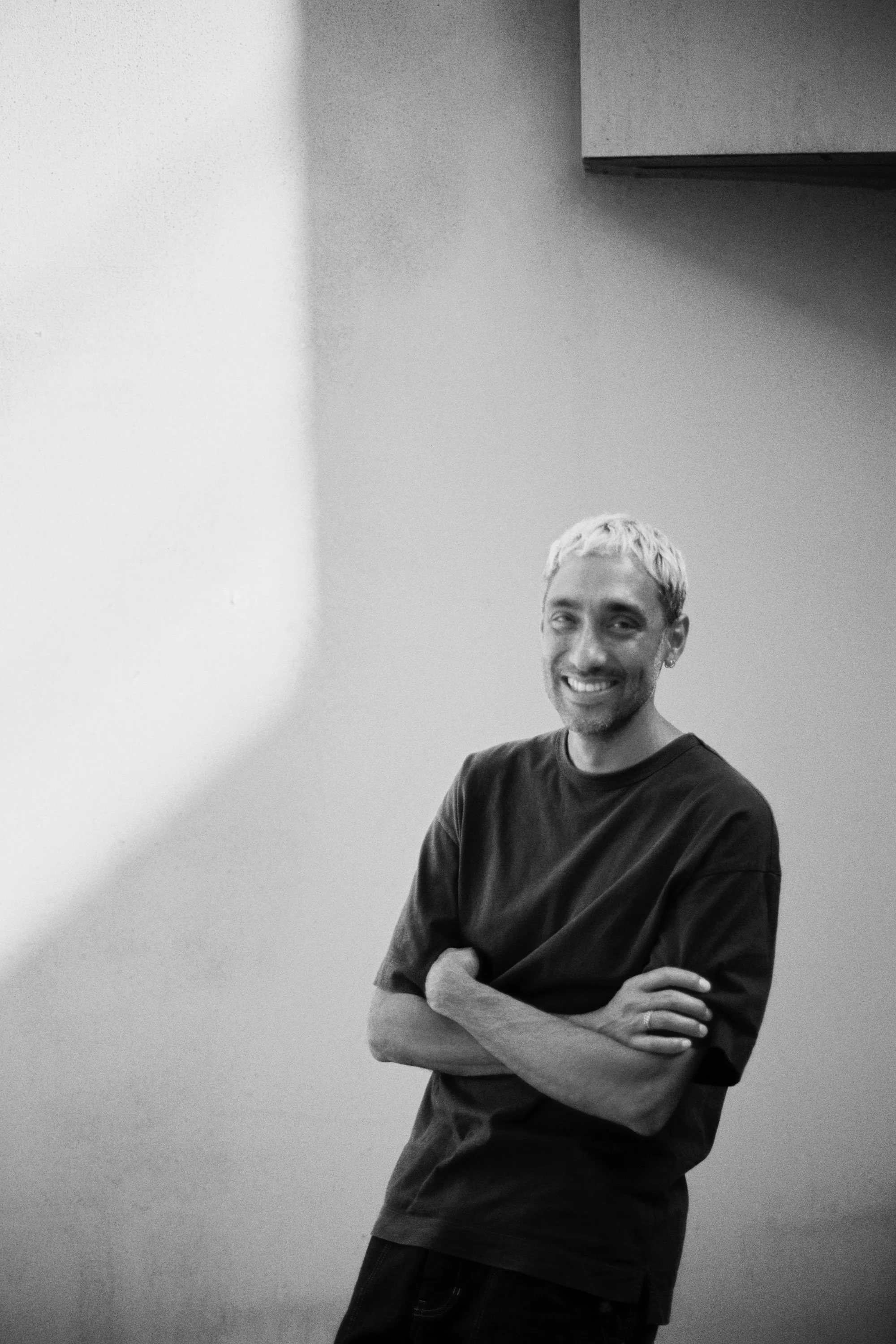
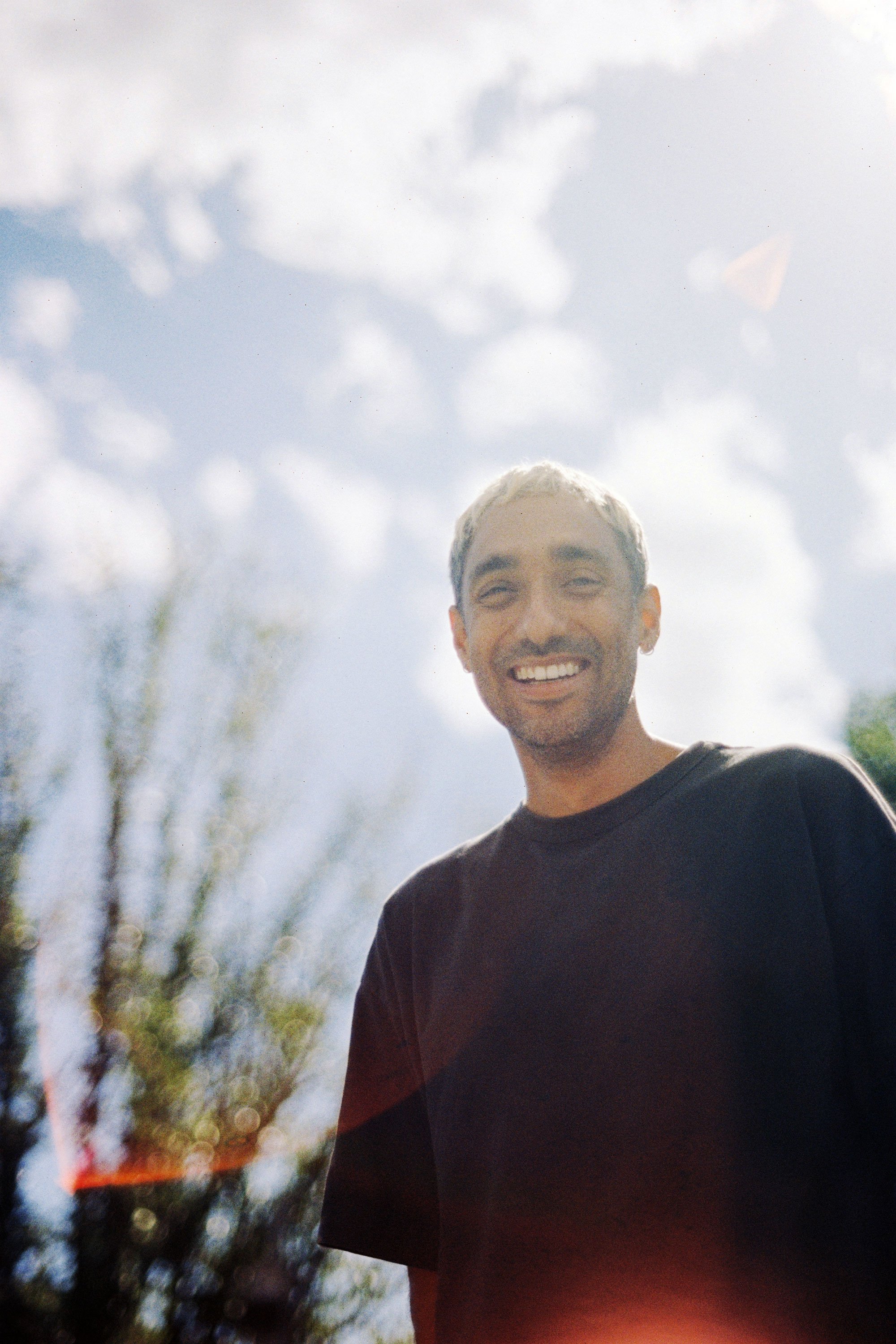
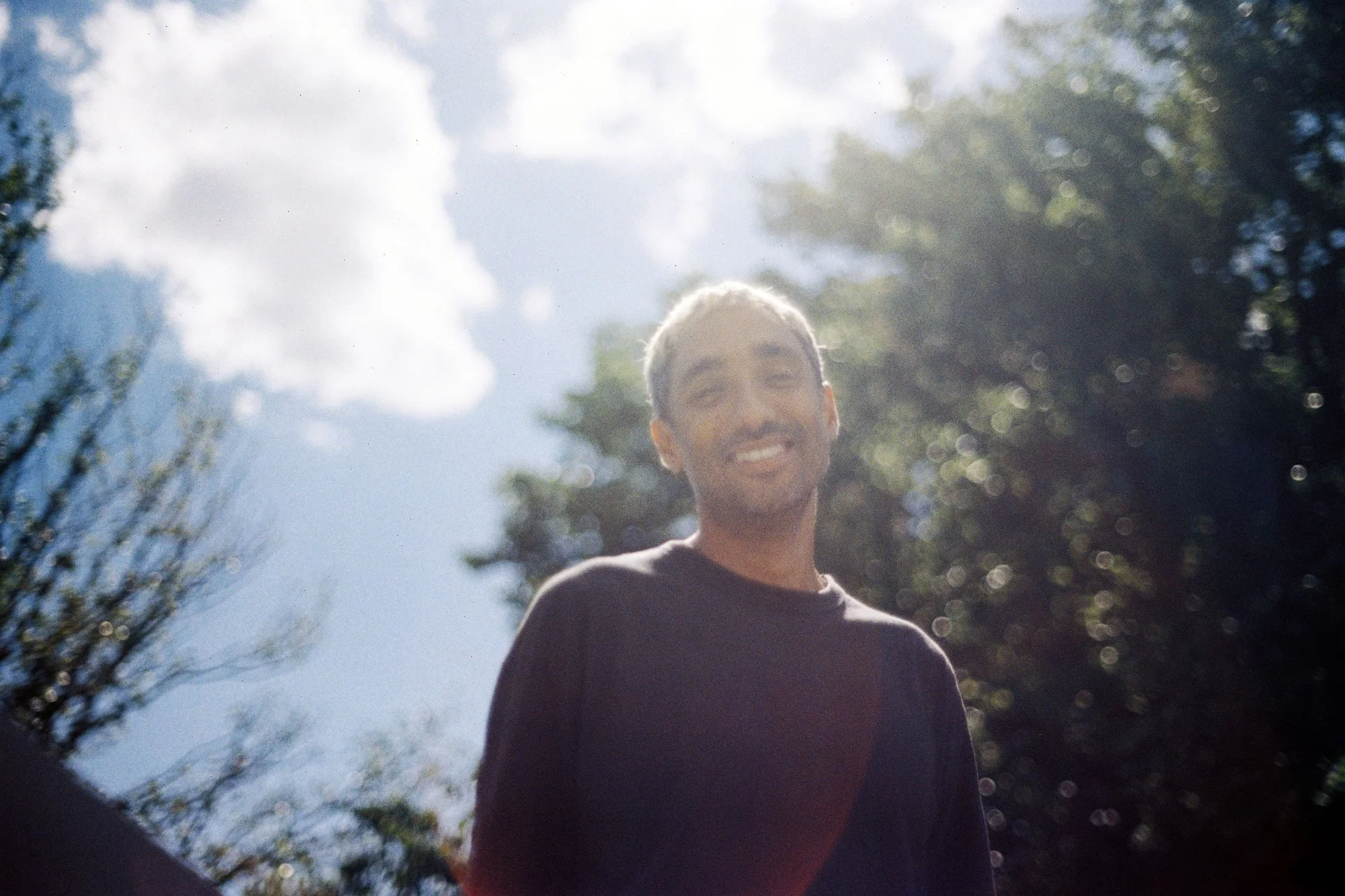
Andrew Brooks is a writer, researcher, and teacher living on Wangal land. He works as a Senior Lecturer in Media and Culture at UNSW. He is a co-editor of the publishing collective Rosa Press and, with Astrid Lorange, is one half of the critical art collective Snack Syndicate.
He is the author of Year of the Ox (Cordite Books), Inferno (Rosa), and the co-author of Homework (Discipline).
Andrew spoke to Thao Phan about making sense of crisis, the idea of poetry as inherently social, and how a song can bend time.

Year of the Ox is your second book of poetry. It follows Inferno, a book among many things, about the fire that propels love, rage, misery, crisis, pop music and collectives of all kinds. Can you tell us about the space between this book and the last? What are the resonances and circulations between them? What traces connect the past (Inferno in 2021) and the present (Year of the Ox in 2025)?
Inferno and Year of the Ox are both attempts to make sense of crisis, or rather, of the compounding crises endemic to late capitalism. The former is a sequence of four long poems that begins with the experience of trying to organise against wage theft in the university when I was working as a casual, then documents the apocalyptic horror of climate collapse in the form of the bush fires that ravaged large swathes of the continent in the summer of 2019–2020, and ends against the backdrop of the pandemic and the mass revolt against the state-sanctioned killing of Black people in the US (and across the world).
The latter book is composed of two long poems: ‘Year of the Ox’ and ‘Dream Gig’. The titular poem takes the Oxen year in the lunar calendar as a loose structuring device to register various discrete moments of crisis and resistance in the past that reverberate into our present: 1901, the federation of colonies into the nation-state of Australia, marking a new phase of Indigenous dispossession; 1829, the development of George and Robert Stephenson’s Rocket, an early innovation in steam locomotive technologies central to the industrial revolution and anthropogenic climate change; 1973, the first in a series of global oil shocks and the final end of the Bretton Woods monetary system, marking the beginning of what Giovanni Arrighi has called the signal crisis of US hegemony; 1997, a year of culture that shaped me as the dot.com bubble approached bursting point; 2009, the age of austerity and the deepening of the Global Financial Crisis; 1949, the intensification of the Malayan Emergency, a counter-insurgency effort by Western powers to dismantle the communist national liberation; 1985, the year of my birth; and so on. ‘Dream Gig’ is a poem that imagines a series of gigs played by a band called Marxist Traitor Child who continually reinvent themselves: grindcore act, cover band, community choir, and so on. It’s a poem about desire and fantasy, dreams and reality, voice and music that tries to get at the separation of difference from differentials, pleasure from abjection.
Both projects are attempts to reckon with crisis as an inevitable condition of capitalism that manifests as an interconnected series of events in which established systems of social reproduction break down. But each project is also about the thing that always accompanies crisis: struggle. My thinking about the inter-relation of these two terms is shaped by the great abolitionist thinker Ruth Wilson Gilmore who writes that ‘crisis is not objectively bad or good, rather, it signals systematic change whose outcome is determined through struggle.’ Crisis implies a time and space in which idled capacities push against each other in a contest over the shape of the future. That the world and its transformations are produced by struggles between antagonistic forces is nothing but an account of the movement of history itself. Crisis crystallises these dynamics, brings them into clearer view, and this is why it remains an enduring preoccupation for me. These poems, then, are not only about crisis as the intensification of immiseration that occurs with each cyclical shock of the colonial capitalist system but are also an attempt to register the processes that produce the transformation of our world. They are about what sustains us in struggle – friendship, solidarity, pop songs, snacks, poems, revolutionary examples. They are an attempt to distil something about struggle into poetic form, to give language to a vision of a world where everyone has access to the things they need in order to live and thrive regardless of their contribution to the social store, which is another way of saying, a vision of communism.
Inferno nods to the first volume of Dante’s epic narrative poem La Commedia in which the poet is forced to traverse the nine concentric circles of the inferno that is hell, each more miserable and depraved than the last. To accompany him on this arduous journey, Dante’s beloved, Beatrice, sent the poet Virgil to his side as a guide. I was drawn to this idea of the people and things that act as guides in our own journey through hell, which is one way to name a world that enables (and facilitates) a genocide to unfold in Gaza or allows the police to kill unarmed people with impunity or cages people as an expression of ‘justice.’ Friends, comrades, teachers, children, poems, songs can all be guides that help us to make a path through the inferno. By guides I don’t mean to imply people or things that lead us so much as things that help us to orient ourselves and endure. The guides we are lucky enough to find on our journey help us to remember that there is something other than hell, and they are what allow us to renew our habits of assembly in order that we might discover ways to struggle again. The path out of hell is marked by those who blockade a port to stop the importation of arms to Israel, burn a cop shop to the ground, facilitate a prison letter writing program, feed and shelter each other, sing to and for each other. Year of the Ox tries to pick these threads up and thinks again with the pleasures of friendship, singing, reading, touching, eating, dancing. It also pursues a dialogue with a certain history of poetics and struggle, making reference to numerous poems through direct quotation and allusion. I thought of the quotations I wove into this manuscript as textual guides and interlocutors in the ongoing project of trying to develop a poetics capable of indexing the struggles of our crisis-laden moment – marked as it is by rising fascism, genocidal violence, political repression, mass incarceration, the waging of war on all forms of difference, white nationalism, anti-trans panics. These moments of intertextuality embrace an idea of poetry as inherently social and collective, something that can be found in folk traditions such as the cuckoo song or in Jack Spicer’s assertion that ‘poems should echo and reecho against each other’ in order to ‘create resonances.’ I’m interested in poetic forms that can reflect the collective and create relations across time and space.
You use the poetic form to pick apart colonial circulations, to corrupt linear history, and to punctuate the story of technocratic capitalism with sublime moments of joyous movement. How do you stay in love with poetry? How do you stay tethered to language with meaning in an age of nonsense speech and machine-made-words-on-demand?
I think aesthetic experience always contains an anarchic potential in that it can open the senses to something beyond the given and the received. Machine-made-words-on-demand, as you put it, are generating an ever-expanding textual corpus that is governed by probability and recombination. As large-language models gain access to more textual data, their capacity to generate legible responses to varied prompts expands. The written word is absorbed by large-language models as raw material for pattern recognition, language is ‘read’ not primarily for content, context, form, or poetics but for probabilistic relations and data patterns. As such, the textual output of generative AI is limited to recombinatory summaries of what already exists, and the output of these models tends to flatten idiosyncrasies in language, or what we might call poetics, into a generic voice and tone.
To riff on the concept of ‘operational images’ proposed by Harun Farocki, Jussi Parikka and others, might this be a kind of ‘operational language’?
Language does things in the world. It can hail us into being (as in Louis Althusser’s famous example of the cop who calls hey, you there! and in the process of turning to face that call interpellates us in being a subject before the law) or it can proclaim (as in colonial declarations of possession) or it can instruct (as in a boss or manager who monitors and directs work). In this way, language has long had operational functions. But the lineage of operationalism you invoke here is linked to computation, describing a type of image developed in the context of militarisation and industrialisation that short-circuits questions of representation, meaning, and interpretation in favour of action, execution, and function. Operational images are not even really images, they are translations of visuality into data points that can be mined for patterns. The processing of language by generative AI tools functions in a resonant way, automating inputs and outputs in a process that circumvents interpretation and analysis as crucial processes for deriving (and negotiating) meaning. This is another example of what Farocki once termed the industrialisation of thought. The linguistic outputs of large-language models don’t just produce an image of thinking but also work to interpellate and discipline us into contemporary modes of production and subservience. My friend and teacher Anna Munster has been doing amazing work on the tonality of text-based generative AI models, arguing they put forward a managerial voice that oscillates between sycophancy and servant leadership. One way to understand this new form of textual production, then, is as a domestication of language to the logics of production and managerialism. For me, the question is not only how we remained tethered to language with shared meaning but also how we might encounter language capable of estranging us from the domesticating forces of technocratic capitalism.
And is this where poetry comes into the equation?
Yes, poetry is one form to pursue both of these aims. One of the things that poetry does is to make language strange. Poetry is always a self-conscious enactment of language, asking its reader to attend to the rhythmic, phonetic, verbal, logical, and nonsensical devices involved in its construction. Poetry is also not necessarily governed by narrative or argumentative coherence. It can proceed by way of association or slippage, it can generate constellations of images that resonate or fragment, it plays with the relation between word, line, and page, and in these ways lends itself to the registration of contradictions, antagonisms, paradoxes, and imaginative leaps. Writing in the context of the Paris Commune and its brutal repression, Arthur Rimbaud argued that the task of poetry was to produce a long systematic derangement of the senses. Capitalism alienates us not only from the products of our own labour but from our own senses which come to be subordinated to the logics of private property. A young Marx made this point in his Economic and Philosophic Manuscripts of 1844 when he wrote: ‘In place of all these physical and mental senses there has therefore come the sheer estrangement of all these senses – the sense of having. The human being had to be reduced to this absolute poverty in order that he might yield his inner wealth to the outer world.’ Rimbaud’s call to derange the senses cannot be disentangled from a desire to destroy the logic of private property that congeals inside bourgeois subjectivity, and which has only intensified in the time that separates our moment from his. The poem, of course, cannot abolish the law of value but it is a literary form capable of registering and reflecting struggles that insist on such a horizon. And when it does take its cues from the streets, the poem uses language in ways that reveal the contingent and arbitrary nature of a social system that places limits on our sensuous capacities. Aesthetic experience in general, and poetry in particular, is one way to re-engage the senses in order to remind ourselves of our shared capacity for pleasure, sensation, desire, and solidarity. Sean Bonney, one of the great poets to take up the task of deranging our senses, put it like this: ‘poetry is stupid, but then again, stupidity is not the absence of intellectual ability but rather the scar of its mutilation.’ I love that formulation and I think it speaks to the importance of poetry in the age of machine-made-words-on-demand which seek a frictionless form of sense-making that intensifies the already existing condition in which humans and our social relations are bound by the iterative and machinic compulsions of capital.
Poetry as “stupidity” feels like a much needed corrective to the fetishisation of smartness we see proliferating today. Orit Halpern uses the phrase “smartness mandate” to describe this contemporary turn to AI-driven, infrastructural “smartness” as a dominant mode of governmentality. Might poetry then be a tactic to abandon smartness? To estrange ourselves from the ghastly forms of instrumentalised knowing reified within operational language?
Definitely. Part of the task of poetry is to tap into an anarchic current attached to our sensuous lives that troubles the fetishisation of smartness, a term which has come to stand-in for ill defined conceptions of efficiency and progress. If poetry can reveal the linguistic artifice of techno-managerialism or provide a rhythmic jolt to the grammar of police realism, then a crucial question is how we make shared meaning from this encounter with a form of language that seeks estrangement. I am interested in poetry as a social form that plays with forms of address and ways of calling its readers into being. Poems are portable, easily passed from hand to hand or read aloud. Poetry is intertextual, speaking back to other poems through direct address or intimation. And it is in these scenes of exchange that shared meaning in language is found and forged, including the possibility of collectively making sense of experiments that trouble the language and grammar of colony and capital.
I also remain attached to the idea that writing is thinking, and so the danger of machine generated words is that the act of thinking is replaced by a mathematical approximation of thought. That thinking happens in the act of writing is true of all forms of writing and so if we remain invested in the circulation of thought, we must continue to write – whether poems, essays, stories, emails, or anything else.
A different (and more succinct) answer to the question of how I stay in love with poetry is simply by reading poets I love: Astrid Lorange, Elena Gomez, Alli Warren, Sean Bonney, Wendy Trevino, Brandon Brown, Fred Moten, Lionel Fogarty, Hasib Hourani, Evelyn Araluen, Gabriel Curtin, Brandon Brown, Kay Gabriel, Diane di Prima, Michael Farrell, June Jordan, Bernadette Mayer, Leslie Kaplan, Aimé Césaire, Amiri Baraka, Chelsea Hart, Ender Başkan, Jazz Money, Divya Victor, Amy De’Ath…
You give one of the most succinct description of algorithmic ways of knowing I’ve ever read:
One, make the map a grid
Two, make all things discrete
Three, make the grid three dimensions
Four, make the grid a vector
Five, make all things into clusters
Six, forget narrative
Your book (and indeed all of your work) fights against this process of automated amnesia. It refuses to forget history, forget narrative, forget who and what is responsible for all of this. Why do you think forgetting has become the dominant form of knowing?
My understanding of algorithmic ways of knowing is indebted to many conversations and reading groups with you and other brilliant friends. It seems to me that forgetting is a by-product of ambition to make the world knowable and readable via the automated collection and processing of vast quantities of data by computational methods. The idea that the accumulation of data will lead us toward a kind of totalising knowledge is, of course, a fantasy but the generalisation of automated decision-making systems has resulted in the displacement of causality by correlation, narrative by prediction, representation by action. My understanding of these epistemological reconfigurations brought about by automation are shaped by the work of Mark Andrejevic and others. Automated systems have produced ways of knowing that foreground pre-emption and operationalism. In the mythologies of the tech sector, pre-emption promises to anticipate emergent needs and threats while operationalism describes forms of action determined by data inputs and outputs. One impact of this paradigm shift is to obscure the narrative logics of causality, which is another way of saying, history itself.
Forgetting is central to the naturalisation of automated technologies as a set of techno-fixes for a world marked by increasing geopolitical instability, climate catastrophe, and prolonged economic downturn. The project of normalising these tools across a range of institutional and disciplinary settings is not only to do with how technologies are used but is also connected to an ideological struggle over common sense. For example, the use of automated weapons systems in Gaza appeals to the techno-solutionist rhetoric of efficiency and precision as a supposedly more ‘humane’ form of killing. Here automated technologies are appealed to in an attempt to insulate Israel from critique as it continues its devastating genocidal campaign. At the same time, the use of automated systems in warfare describes a qualitative shift in how war is waged in which the relation between the processing of surveillance data and the actioning of strikes is increasingly shaped by algorithmically determined correlations in data, enabling the acceleration of strikes. While correlation does not necessarily indicate an absence of causation, it also does not always imply a causal relation. Automated systems seek to circumvent the question of causality, which we might understand through your succinct formulation as the automation of amnesia. In the context of Gaza, the various technical and ideological debates over Israel’s use of automated weapons in a genocide perhaps is designed to encourage the world to forget that Israel’s genocidal intent is a continuous feature of its occupation. It is only by remembering – that is, by attending to history – that we can identify causality. And the question of causality remains crucial because it allows us to understand where we might intervene in the world. We must attend to history in its short and long durées in order to identify interventions that can break the starvation of Gaza, end the genocidal violence, and free Palestine.
The book is split into two poems: Year of the Ox and Dream Gig. The first feels like a montage of moments brought together by the plough of the ox, as André Dao writes in the introduction ‘The poem takes what has been — oil crisis, emergency in Malaysia, the Global Financial crisis — and flashes it together with the now, with blackberries, garden spiders, broccoli pasta: those things that are “good/as narrated by Arvind Rosa.”’ It spans scale, history, intimacy, and sensations: ‘acrid + sweet, soft + hard.’ The second is pure jubilance. As if to say, after all that careful work, don’t we all just need to surrender, to give ourselves over to wild, ecstatic, and corrupt desire. In your words ‘convulsive intolerance against compulsive order.’ I really love this and it actually reminded me of a documentary I watched about boy bands a few years ago which featured a whole lot of footage of girls screaming in pure hysteria. I was so enthralled, so happy but was then overwhelmed with sadness because I realised that I couldn’t remember the last time I loved something so much that I screamed. It’s like without knowing it I had let go of the child within me, and it has happened so gradually I hadn’t noticed until that exact moment. How do we ‘get words out of [our] mouths and into [our] hearts’? How do we embrace our inner Marxist Traitor Child?
My daughter loves Olivia Rodrigo and last year when she toured, a friend hooked us up with some free tickets to her concert. At the time my daughter was six and so this was the first big concert she’d ever been to. When Rodrigo came on, forty thousand tweens screamed with an intensity that was so pure. I found it so moving. At first, my daughter was kind of terrified by the fevered excitement and wanted to leave. So we stepped out of the stadium and found a quieter place to chat. My partner and I suggested to her that we try going back in for a minute, and that this time she might try joining in when everyone else screams and see what that feels like. We went back in and the crowd went wild again but this time, my daughter joined in and completely lost herself in the collective fervour. It was so beautiful and joyous to watch that moment of abandon.
There is a resonant contagiousness in those moments of riotous upheaval in which the streets are overrun by the people, even if only temporarily. One of the challenges we face is how to remain open to these moments of wild and ecstatic desire that allow us to feel for the shape of something beyond the given terms of order. I think children are very good at teaching us something about how to do this. Their play often turns around events that unfold unpredictably and requires improvised movements within and against the idea of agency. Play demands a kind of reciprocal attunement in which one is forced to negotiate when to yield and when to resist in ways that can help us to understand how to enter collective experiments that seek social transformation. The work of art can also foster forms of encounter that might help us to feel our way toward emergent forms of communality and opposition. This brings us back to the anarchic potential of the aesthetic and to the role of play in the arts as something that can help us to remain open to the emergence of an us.
You write ‘the alchemy of the three-minute pop song is that it is a container for all that is uncontainable.’ You are so intoxicated with pop music as a source of irrepressible movement, both physical and political. What did you listen to while writing this book? What is the soundtrack for your revolution?
I am intoxicated by music in general, and by pop specifically. Songs can really fuck you up and that makes them kind of magical. A song can bend time, can make three minutes feel as if it might stretch for an eternity. A song can move us – to dance, cry, sing. John Berger once wrote that ‘a song, when being sung and played, acquires a body. And it does this by taking over and briefly possessing existent bodies.’ It is, in other words, a social form that allows us to encounter a kind of excess that takes hold of us and moves us into relation.
Pop songs are cultural artifacts that, in their popularity, index moments of shared identification. A pop song, like a poem, can make the everyday strange and novel or it can reach for the fantastic. Our shared identification with a pop song can become a vessel for a collective that ultimately exceeds the song. As a commodity object, the pop song dreams of universality but is ultimately of its moment, an expression of what is happening in the here and now. This does not necessarily mean it withers away into irrelevance. The excess that a pop song contains might persist in ways that animate future anthems or the structure of feeling it captures might endure in ways that render the song a classic. A pop song can reflect something of shared conditions in a given movement back to us, offering us an object that holds our desires, anxieties, hopes, fears. Ultimately the pop song invests in the ephemeral, it is about coming together in the here and now, and so perhaps is also a tacit acknowledgement of the fragility of the future. Poetry is connected to histories of song, to questions of rhythm and harmony. And this shared lineage is another reason why music is so present in my poetry.
Some of what I was listening to as I wrote this book appears in the book itself: Sly and the Family Stone, Busta Rhymes feat. Janet Jackson, Cornershop and Fatboy Slim’s remix of Cornershop, Nina Simone, Bad Brains, T. Morimoto and DJ Plead, Alice Coltrane, New York Eye and Ear, Arthur Russell, Prince, Fine Young Cannibals, Pharoah Sanders, Archie Shepp, Mariah Carey, The Emotions, Julius Eastman, S.P. Balasubrahmanyam and Vani Jayaram. The soundtrack to my revolution takes its cues from Brecht: ‘In the dark times / Will there be singing? / There will be singing / Of the dark times.’
The next time it will be the year of the ox is 2033. Can I use your words against you and invite you to ‘don a linen suit and play futures forecaster’? What do you think the future will say about the present? About the things we’ve done or allowed to happen? How will the violence of our present arrive in their future?
We are moving into futures marked by deepening crises. Climate collapse and the end of growth suggest the intensification of uncertainty and the amplification of antagonism. We are, and will continue, to be forced to confront new forms of fascism, political repression, and state violence. I am certain that we will look back at this moment and feel the devastation of a genocide that we have not yet been able to arrest. We will look back on the unchecked extractivism that marks our present as a tragic story of greed. We will look back on the history of colonialism, which is also a history of racialisation, as one of misery, violence, and subjugation. But the future is also not foreclosed and so your question impels us to find new tactics for meeting these imminent threats and overcoming them. For this task we will need guides in the form of comrades, friends, songs, and much more. And we will need poetry, too. My desire is to cultivate these things so that we might keep a revolutionary future open.
Find out more
Interview by Thao Phan
Photographs by Leah Jing McIntosh