
5 Questions with Eric Jiang
by Andrew Cordon
Eric Jiang is a queer Chinese Australian playwright and poet, living and working on Gadigal land. His play lacuna enjoyed a critically acclaimed season as part of Griffin Theatre Company's Lookout program; his plays have been published by Australian Plays Transform and Currency Press.
Eric speaks to Liminal about his latest play, Rhomboid, appearing as part of Melbourne Fringe Festival, 1–11 October, 2026.
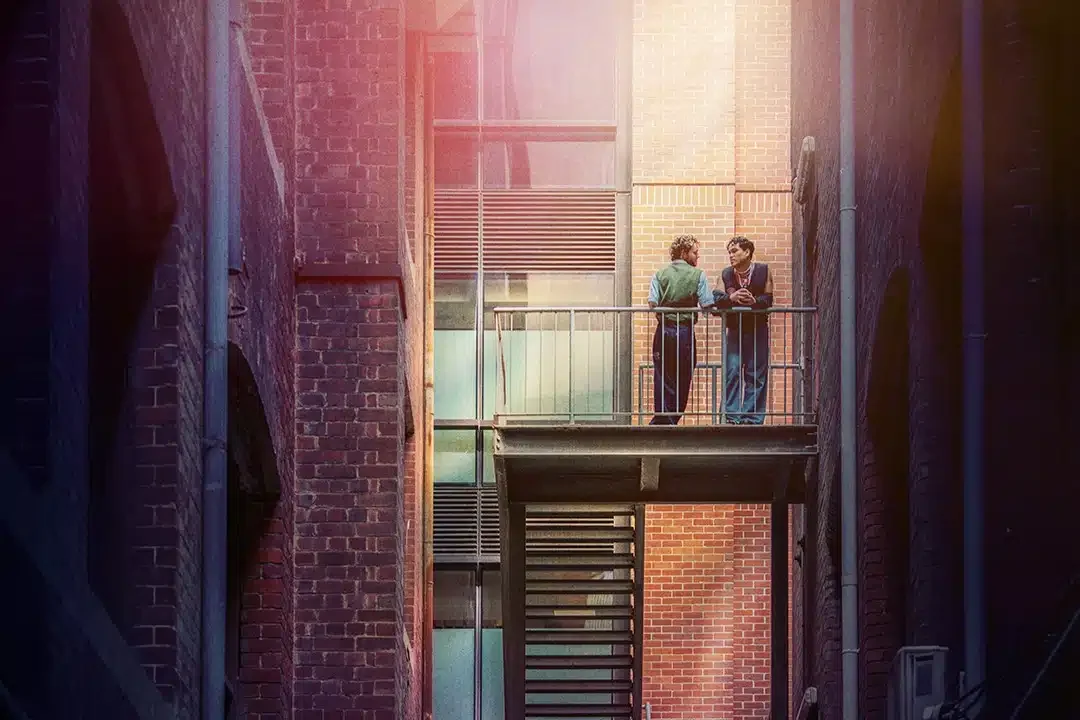
(Credit: George Jefford)
No.1
Hey Eric. You’ve written across a multitude of forms: poetry, criticism, screenplays and plays. Do you find your approach to writing moves across disciplines?
I’ll think about this in terms of playwriting and poetry. Plays are huge, poetry is nimble. The vast difference in how collaborative they are is what informs my approach. In theatre, I’ll try to convey an image or feeling or impossible action in a stage direction and know that someone else has to deal with that. Whereas in poetry that’s me – I’m perpetually throwing new drafts to my future self.
Because there are so many more constraints to a play—i.e. it’s beholden to narrative and dramatic tenets—there’s always something to reshape, a new lens with which to look at the work. With so many people involved we’re all contributing to the process, it’s self-generating. With poetry I’ve picked up bits and pieces of process from editors, workshops or they’ve come from happy mistakes I’ve since repeated.
I do feel like in theatre because the text will pass through so many hands and lift off the page with its own new life, I like my poetry firmly planted on the page. Playwriting feels like poetry at key moments of the process, like being in between Previews and trying to fix a moment with a change of one or two words. In general, I like my dialogue unassuming, because usually my poetic tendencies will kick back in at some point no matter how I hard I try.
No.2
You’ve said elsewhere that Rhomboid explores the “limits of language,” especially when it comes to labelling feelings that seem beyond comprehension. I was wondering how you came to this desire to explore such limits.
I love metaphors that push out at the edge of sense which my favourite poetry does super well. There’s a thrill in that collision. Tangentially, I’m fascinated by friendship and love, and the way these words could mean any number of things. They can have expansive, beautiful meanings but are equally susceptible to flattening or banal versions of themselves.
The key relationship in Rhomboid came from a relationship that didn’t feel easily categorisable, which meant that it felt like there was no guide for what to do. Can you ask for what you want if you don’t have the words? Conversely, I like to think about when does poetry fail us? When does shaping something into a story fail us? It makes me think of a great Joanna Newsom lyric: “Never get so attached to a poem you forget truth that lacks lyricism”.
No. 3
Origin Story, lacuna and Rhomboid seem to share the desire to explore human connection across fragmented temporality. What draws you to the exploration of time and memories?
I do feel like there has been a general renewed interest in asking our parents about their lives, and family history which is never freely given. For me it feels like a way to connect to my parents and uncover piercing details that remind you of the richness of your life and lineage, to be reminded of all of those glimmers of courage and brilliance and doubt and decisions.
I’m still grappling with what to do with this knowing. Is it a worthy pursuit to turn these details into narrative? Why put this effort into remembering? In a work, why evoke the past and the present? Is there something more specific to say about how the past affects the present?
In my research I’ve found things that have been unexpected, the illumination of repeated struggles. I love knowing I belong to a certain lineage, whether that’s biological, or queer, or literary. I love stories that have escaped the archive and can be nurtured back to life in all of their scrappy, misshapen meanings. I love knowing the sheer breadth of what kinds of lives have happened, and therefore what kinds of lives are possible.
No. 4
It seems you’ve experienced your own time jump of three years between Rhomboid’s first run in 2023 to now, for the upcoming Melbourne Fringe Festival. Across these years, have you experienced a similar shift in the relationship with your own work and artistic process?
I was curious about what it would feel like to hear the play at the readthrough after three years, but I’m happy to report it still holds up. The play affected my relationship with the person it’s based on, and some of the events that occur in the play have now transpired in real life. It’s also folded in with the relationships I made with the cast of the original show—it’s all a very nice feeling.
Of course, so much has changed. Rhomboid was my first produced play! It seems miraculous that it happened. I didn’t know anything about playwriting really, or how to be as the writer of a production. I think during that time I didn’t know in my bones the true collaborative nature of theatre, and how meaning is created not just from the text but performance, design, direction. I’m definitely more trusting now.
In lacuna, my last play, I specifically tried to really lean into leaving space for other people to come in—design, direction. And to write gestures that they would complete. I think I’ve learnt how to regard my work with the right amount of love and criticism. A play is never the same as what I imagined in my head. It’s much much better.
No. 5
Can you share some insights from your writing journey that may help emerging playwrights?
I didn’t go to university for writing, but I’ve been lucky to do programs geared towards young writers, and I’m so grateful to everyone who’s ever taught me anything. So I’d say check the cut-off ages for those programs, and don’t feel lesser to anyone with a relevant degree. I also think independent shows are their own gift, and don’t have to be a stepping stone to something else. To have audiences that are mostly filled with the people you want to speak to is a gift. To have an intimate venue is special. I think yes be “ambitious”, but ambitious shouldn’t default to the main stage. Big theatres should be lucky to share your voice. If you can love every space your work can exist, you’ll probably be happier.
Process-wise: When it’s time to drop the pen, you’d best drop the pen.
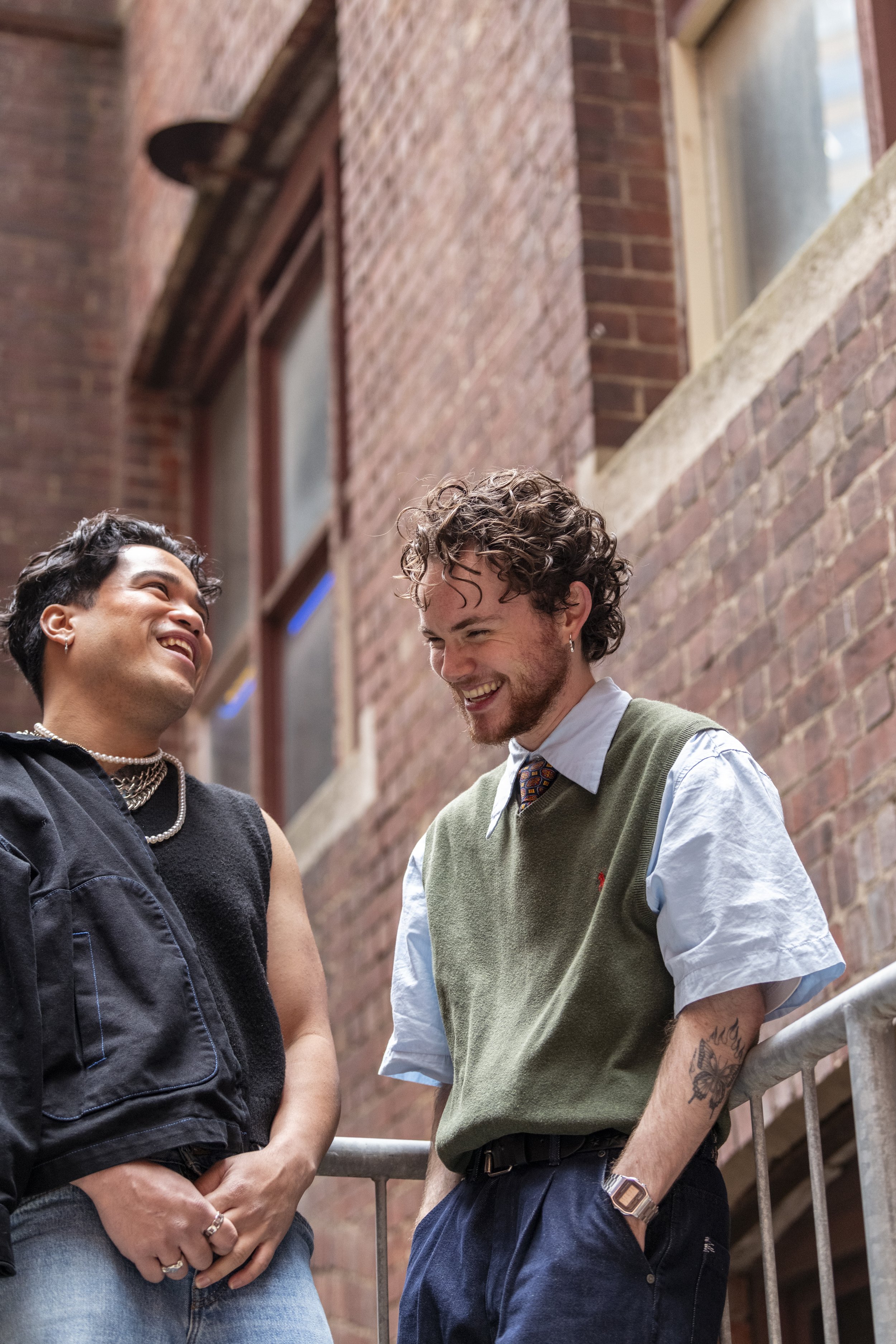
(Credit: George Jefford)
Find out more
Rhomboid appears as part of Melbourne Fringe Festival, October 1–11. Tickets here.
Xavier meets Sebastian in high school. They instantly hit it off, but it doesn’t take long for things to get complicated. Moving through university and into the real world, they miss each other, find new partners, have chaotic encounters, and make their own way. For Xavier, the allure of a promising future smashes into a murky reality – especially as a queer Asian-Australian. As he fumbles through relationships and unusual friendships, Xavier continues to orbit Sebastian, sometimes closely, sometimes from afar, infuriating him and craving him in equal measure as they gradually figure out what they mean to each other.
Presented by fortyfivedownstairs as part of the 2026 Fringe Festival, Margot Morales (And She Would Stand Like This, Antipodes Theatre) directs the Melbourne premiere of this funny and touching play by Eric Jiang (Lacuna, Griffin Theatre) about the unexpected forms love takes.