
5 Questions with Matthew Sze
By Andrew Cordon
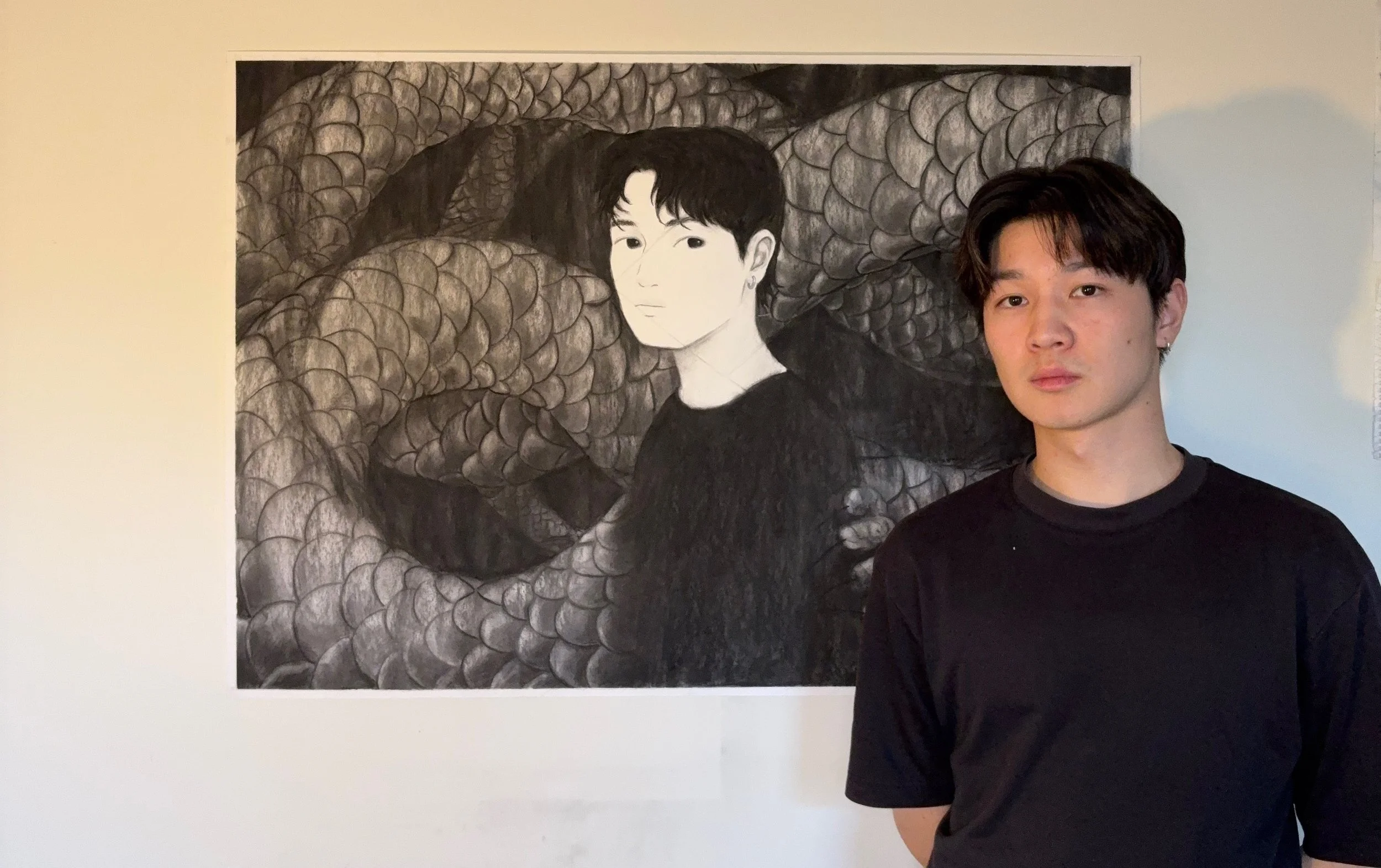
Matthew Sze is an artist from Naarm/Melbourne. He graduated from VCA in 2024 with a Bachelor of Fine Arts, specialising in drawing and printmaking.His work explores the intersection between traditional Chinese spirituality and its transformations through a lens of evolution.
He has both curated and created artwork for his most recent group exhibition: 根ROOT, highlighting both the preservation and new interpretations of Chinese traditions.
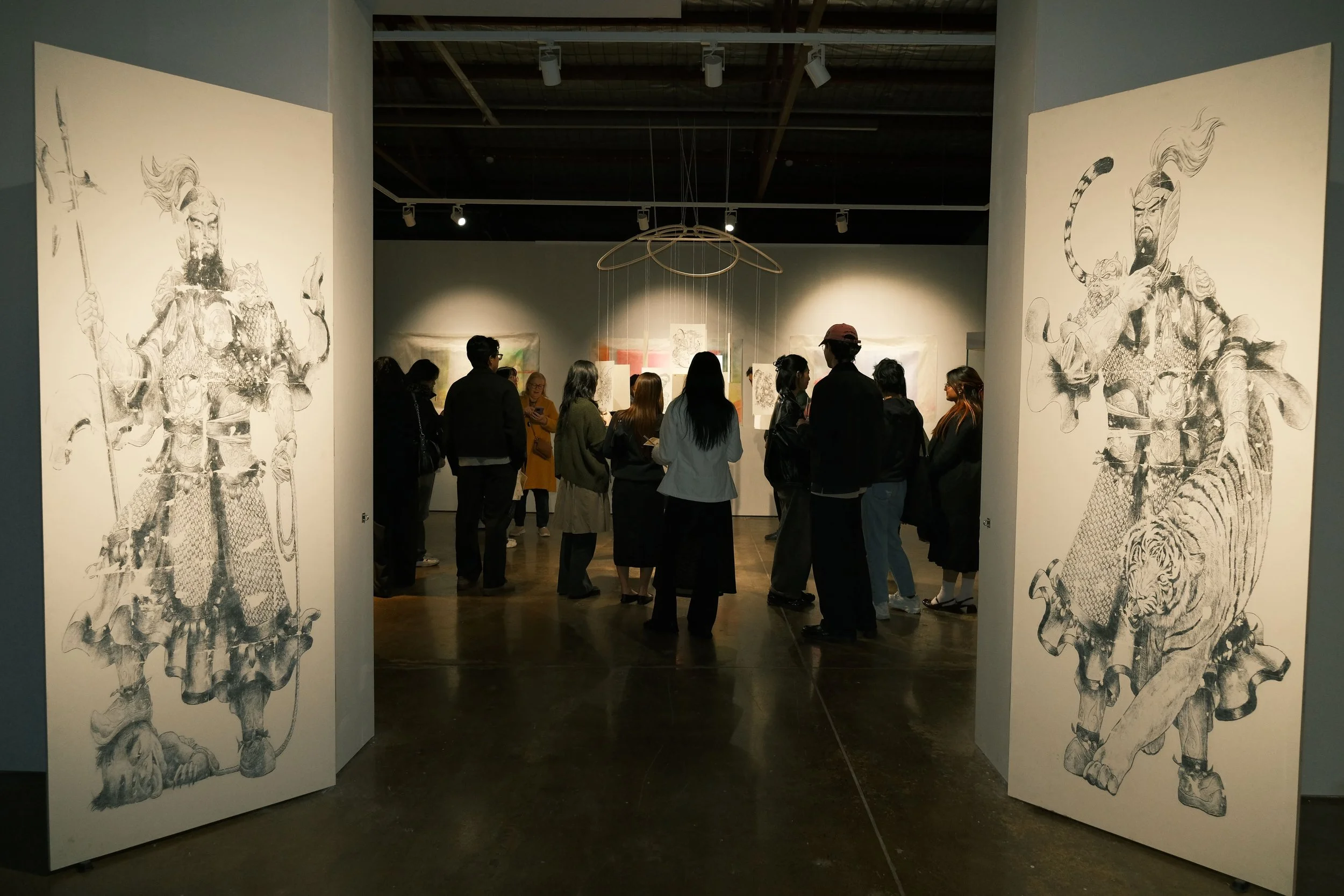
Opening Night. (Image Supplied)
No.1
The aim of 根ROOT is to reflect a “relationship with rituals and beliefs.” Can you speak further to this?
The entire process of my piece in the exhibition ‘Temporary Guardians’, from creating the work to then installing it in the space, acted as a ritual itself. The moment the doors were installed in the gallery, they acted as an invitation to the gods to enter the space to serve their purpose. In this case, it was to guard the gallery for the four days the exhibition was open, and de-installing the artwork acts as a send-off and a gesture of appreciation. Art is inherently spiritual. All of the artwork seen in Root embodies the aspect of ritual that goes beyond the work itself. The final works on display are only one small part of this ritual, and it is really important to honour the whole journey.
No. 2
Though you were born in Australia, you spent some of your teenage years at a boarding school in China—has this impacted your relationship to spirituality?
I have always been interested in culture and mythology for a very young age. When I was in China, I took a lot of those experiences for granted. Seeing rituals being practiced every day such as the way people pray to their ancestors, lighting incense, or visiting temples that were just 10 minutes away from your house. I was quite young, so I didn’t think too deeply about it, but there was always a mysterious quality to these practices that allowed them to stick with me even as I returned to Australia.
As I got older, it was interesting to be able to observe the same rituals practiced in another country. It helps a lot when you observe something firsthand in person; it is very different to reading an article or watching a video online. In retrospect, I am extremely grateful that I had the privilege to experience and witness these practices from a young age, and the ability to compare the beliefs and rituals between different contexts is a major factor that I always try to showcase through my artwork and the entire process of creating something.
No. 3
How do you think the relationship between today’s culture and spirituality has evolved?
That is a big question! I personally think that we are in the midst of a new era of spirituality that has just started blossoming. I feel like the abundance of technology and how rapidly it evolves has made us almost want to go back to traditional practices to seek spiritual guidance. Going back to their roots!
Of course, culture is tied to spirituality and I think especially here in Australia, I’ve seen a lot of people whether it is online or those around me discuss their desires to delve into their culture. I guess it is a part of the experience that comes with having immigrant parents, the shift in mentality from high school compared to now, right? We just need something that can encourage us to unlearn the embedded shame and actually be inquisitive toward the beliefs of where we came from. It’s really nice to see younger people be more willing to learn about their own culture and its spiritual aspects, but I can’t help but be slightly concerned with how things like AI or political turmoil can compromise the desire for knowledge on our multiculturalism.
No. 4
根ROOT was your first experience curating an exhibit. What were your biggest lessons throughout the process— would you give any advice would you give to early career curators?
The biggest lesson I learned was that you can’t do everything on your own. The whole process is almost like a ritual of forging a community and fostering shared beliefs that is channelled in everyone’s work. Having supportive friends and family, and also the relationship between yourself and the artists allows for effort and celebration to be shared together. Not having experience with curating meant I was really learning as I went through this whole thing. Being prepared and giving yourself lots of time to go through venues and really explore your options with everything is important. I honestly would’ve wanted a few more months – even a year – to really map everything out while being mindful of timing.
As both an artist and the curator for a group exhibition, I probably wouldn’t do both at the same time again. Maybe sticking to just curating next time would let me have a greater focus on things like communication between myself and the other artists. It was very hard to balance the side that needs to produce work with the side that checks up on the status and progress of things from other people, but it was definitely a learning experience that has shaped me.
No. 5
Where do you draw your inspiration from?
I had just travelled back to China at the end of 2025, and that was the catalyst for the whole exhibition. Witnessing how traditional rituals were integrated into modern life, which aspects are still important now and how it has shaped culture were all factors that led to Root. Having the privilege to travel and to experience things firsthand is something I am really grateful for. Besides that, I draw lots of inspiration from ancient Chinese art: cave paintings, stone carvings and religious imagery. Observing their techniques and materials always fascinated me, especially as a kid, and I love experimenting with ways that I can use some of those techniques within my work now. I love seeing how all of these factors culminated as a reflection of ancient culture and what parts of it are still being used now.
Matthew Sze. (Image Supplied)
Find out more
根ROOT explores spirituality in traditional Chinese culture through a contemporary lens. The gallery becomes a temple, a reflection of our relationship with rituals and beliefs. The exhibition highlights preservation of traditions and new interpretations of the past.
Visit 根ROOT from 7–10 May, e+Hive Gallery, Collingwood.