
5 Questions with Vee Shi
Vee Shi is a filmmaker whose work has been recognised by the Australian Academy of Cinema and Television Arts Awards, the Screen Producers Australia Awards and the Iris Prize. He is a recipient of the Australian Directors’ Guild and Australian Writers’ Guild awards. Vee wrote, directed and produced Time and Tide, working with collaborator and cinematographer Nicholson Ren.
Time and Tide world-premiered in competition at Visions du Réel 2026. The film has gone on to win the Documentary Australia Award at the 73rd Sydney Film Festival, and has been selected to screen at the Busan International Film Festival. Initially conceived of as a scripted film, Time and Tide captures Vee’s return to his hometown, Longtian, in south-eastern China after his father suffers a stroke.
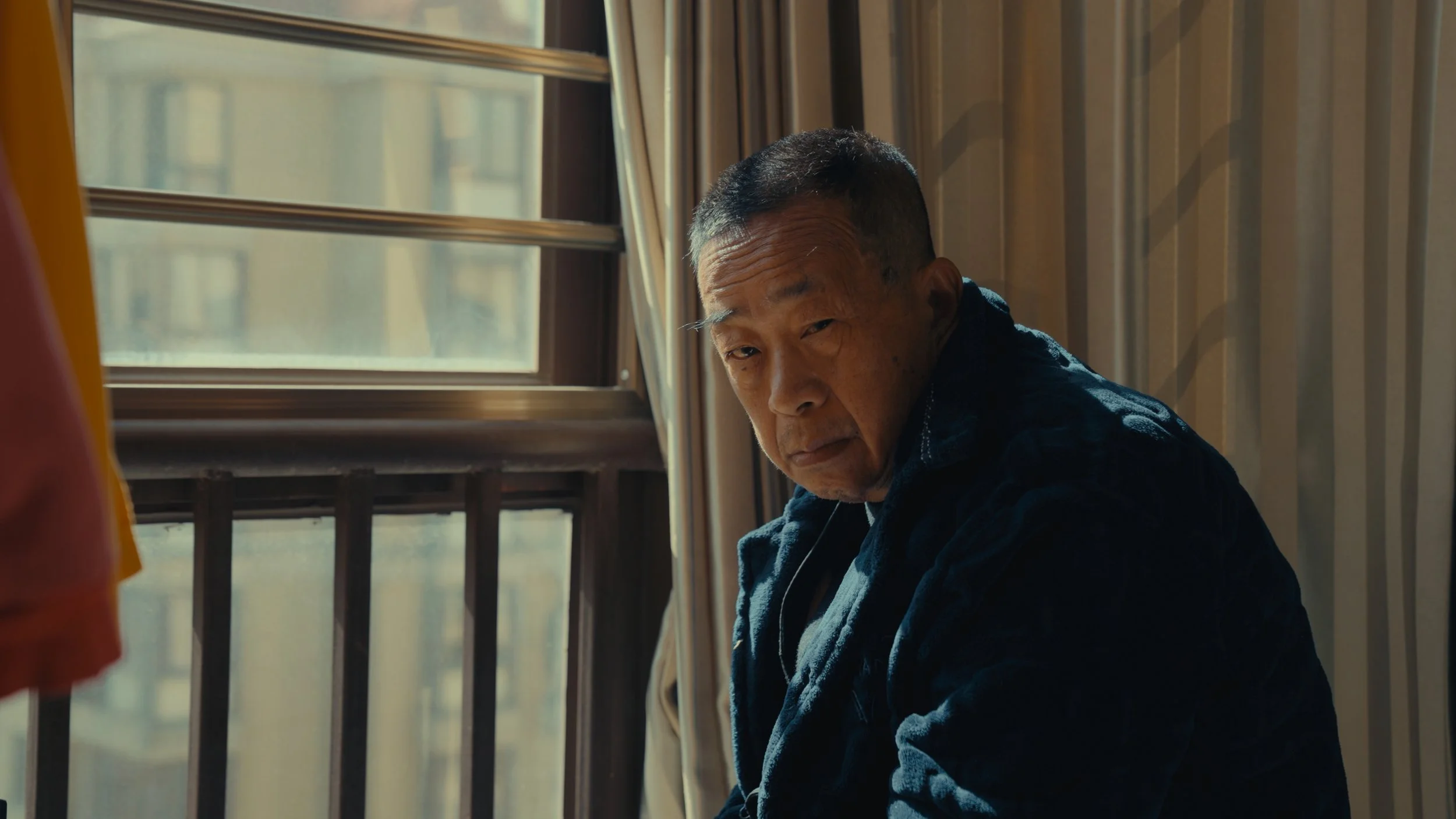
Still from Time and Tide (Supplied)
No.1
The family is central in Jia and in Time and Tide. I remember you saying it is a theme you come back to in your work. Why do you think that is?
I don't know for certain, but it might have something to do with the fact that I have always felt the love of my family, no matter where I am or how long we've been apart. This is especially evident in my relationship with my mum. Her love for me has been the one constant in my life, despite us being separated for most of it since I was thirteen. Her love is like gravity. It makes me feel safe, and it keeps me and my work grounded, and it's the foundation from which I build a world in film.
No.2
In your interview with Revue, you spoke about how translation features in Time and Tide. Did you want to talk about that a little more?
One of the things I struggled with was translating the family for a wider audience. Initially I wanted to drop the audience into the family, and let them figure out what’s happening. If you come from a traditional Chinese family, you know immediately what’s happening [in the film]: that it’s the grandparents looking after the grandsons, that you’ve got the mum working somewhere else. But with the initial feedback we had, the audience asked a lot of questions. Where did Vee come from? What was he doing in Australia?
There were a lot of unnecessary questions that hindered the audience from knowing the characters and the story, so I went back the next year and shot more things. Initially I was resistant, but if half the time, the audience is figuring out who is who, I thought, that is not the experience I want to be giving them. Coming back to your question on translation, Nicholson can understand Mandarin partly, but that’s not his native language—and when my mum speaks the Fuqing dialect, he doesn’t understand it at all. But Nicholson told me he could tell by their physical movements, by the way they speak, what was important or not.
For me, when I speak Mandarin compared to when I speak English, I feel like two different people. My personality changes. For my mum, she only learnt Mandarin in her 30s or 40s, so the most natural language for her is her dialect. She’s so fierce—she’s louder—in her own language. That’s her true self. Before we started filming, she assumed that I wanted her to speak in Mandarin, and I said, no, I want you to speak Fuqing, because that is you.
I’m so glad I did that, because listening back, I can hear, that is my mum.
What does the role of the translator and the role of the filmmaker mean for you?
A good translator stays true to the meaning while understanding the nuances of two cultures—it's never purely word for word. I’m a certified Mandarin and English interpreter, so one thing I learnt was that you always translate for meaning. The cultural nuance doesn’t survive the literal translation. [For Time and Tide], I had to translate from my dialect to Mandarin for the subtitles, and then translate that into English. Nicholson and I had so many discussions over single words: is this the right word? A few times, I would agree with him, but other times, I said, you just have to trust me. I know it’s not the direct translation of the word, but in English, this is the best version.
As a filmmaker working between cultures, I love taking audiences to places and stories they may not be familiar with, and presenting them in a film language that feels accessible without losing its cultural specificity. I feel like we have achieved that balance in Time and Tide.
In your interview with Senses of Cinema, you mention that you gave Nicholson very minimal notes, that his shots were as if he could read your mind. It's such a beautiful image of long-term collaboration between a filmmaker and a cinematographer. Can you describe your collaborative process with Nicholson?
I met Nicholson on a VCA film set over a decade ago and we've become close friends. Before Time and Tide, I'd worked as his camera assistant, and as a director and producer across numerous short form projects together. Our short film Jia was really where we consolidated our creative partnership. For that film we went deep on every scene—the intention behind it, the visual style, everything. We repeated that process on Time and Tide, drawing on inspirations from other films and working out the composition, look and feel we were after. We also talked at length about the importance of truth—for Time and Tide to work, it had to be honest and authentic above all else. So by the time we started filming, Nicholson knew exactly what we were going for, which meant I could focus on directing and being in front of the camera.
You talk about knowing the shot with your father and your mother as being one of the last scenes. How did you know that was how you wanted to end Time and Tide?
Initially, in the screenplay I wrote, the ending was that the son leaves, and the family goes back to normal, mundane life. I wanted to capture that sense of feeling that it’s really hard to impart change. When my sister came to Fuqing, I realised that my sister had to be a bigger part of the story. So I actually wrote and shot a new ending for the fiction film where my sister dies.
For me, when I respond to films, it’s when I experience this sense of regret. That’s what I felt my dad experienced after his fight with my sister. So I wrote this scene where my sister gets into the lift in her apartment building, and we come down to the ground floor, and it opens, but she never comes out. But we hear her ringtone, so it’s a bit ambiguous as to what happened. It ends with my dad calling her, but she’s not picking up.
I wanted to convey this feeling of regret, but once I saw that shot of my mum and my dad, I felt something so strongly. It captures my initial intention more. You feel that life goes on, but you can never truly understand what happened within the family unless you see it.
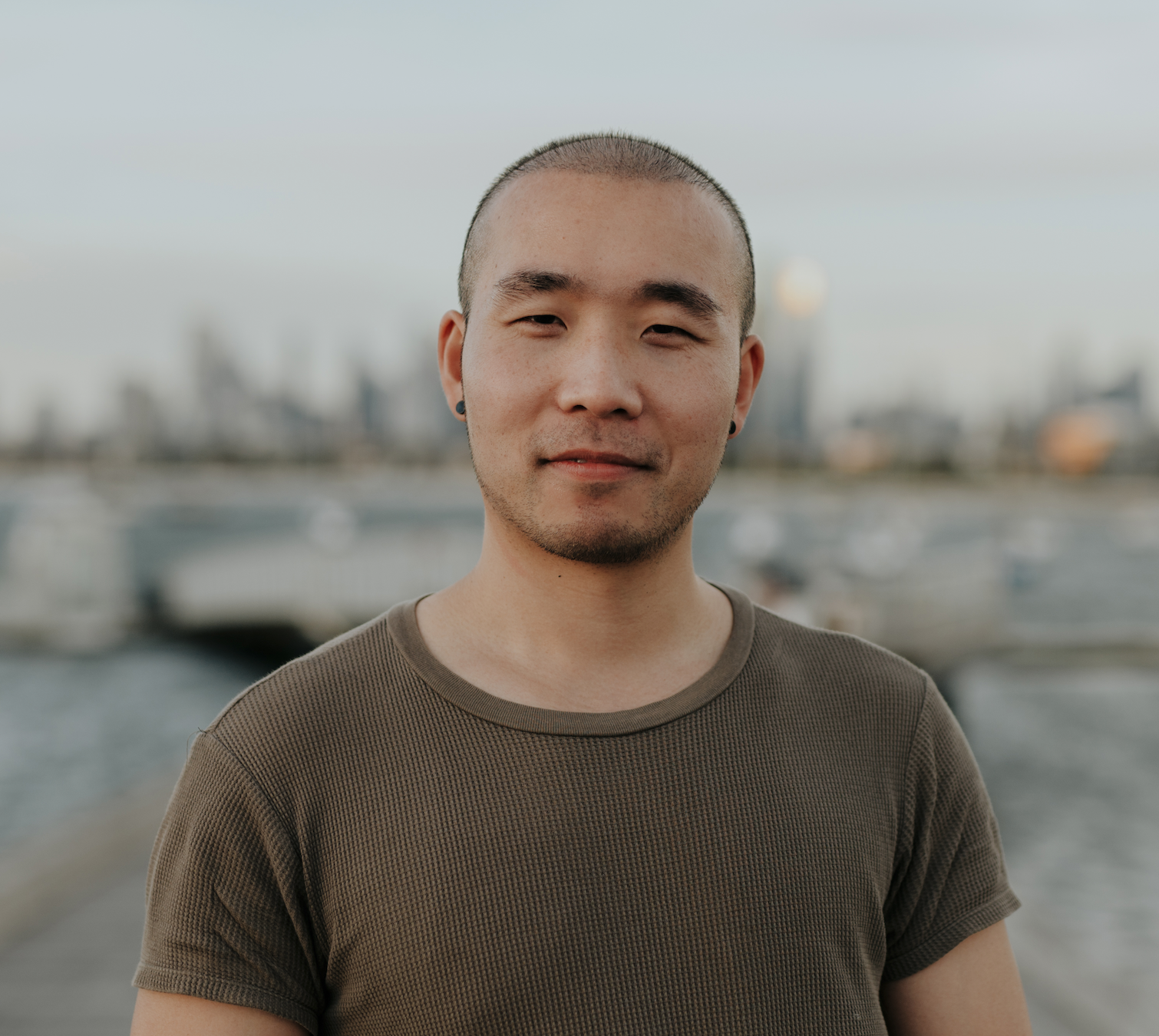
Vee Shi, photographed by Rachel May (supplied)
Find out more
When his father suffers a stroke, Melbourne-based filmmaker Vee Shi returns to his hometown, Longtian, Fuqing, in south-eastern China, a small rural community that he left behind when he was thirteen. As the family’s proud, stubborn patriarch struggles with his compromised health and need for care, his estranged wife and daughter —who, due to China’s one-child policy, was given up for adoption prior to the director’s birth—are suddenly entrusted with the duty, and burden, of looking after a man who has often treated them badly. These strained family dynamics evoke a bigger-picture portrait of changing Chinese society and social values, where the once-total dedication to family is falling away.
Time and Tide is the first film ever to be shot in Longtian, and only the second to feature the disappearing Fuqing dialect—profoundly and often painfully extends that inquiry to the contested space of a fractured family home. Premiering at the Melbourne International Film Festival earlier this year, you can catch a wider release in Melbourne and Sydney, 10–24 September, 2026.